Firefly Platform Overview
A child with complex medical needs might see a dozen or more doctors, specialists, therapists, and school staff, take multiple medications, and depend on coordination across everyone in their care circle: the pediatrician, the school nurse, the grandparent who watches them on Thursdays. Their family carries a heavy load, and even with great support, there's a lot to keep track of.
Firefly is a family app, first. It gives parents one place to organize their child's care, connect with their support team, and access the resources they need. On their phone, where they actually need it. At the doctor's office, on the couch after bedtime, in the ER at 2am.
PPCC is bringing Firefly to the families they serve, building on what families started with Lightning Bug and adding tools that didn't exist before: a complete health profile, an emergency card a parent can hand to a nurse, and AI-powered quick capture.
What Families See
These are the actual screens families use. Firefly is designed so a tired parent on their phone at 11pm can get what they need without thinking.
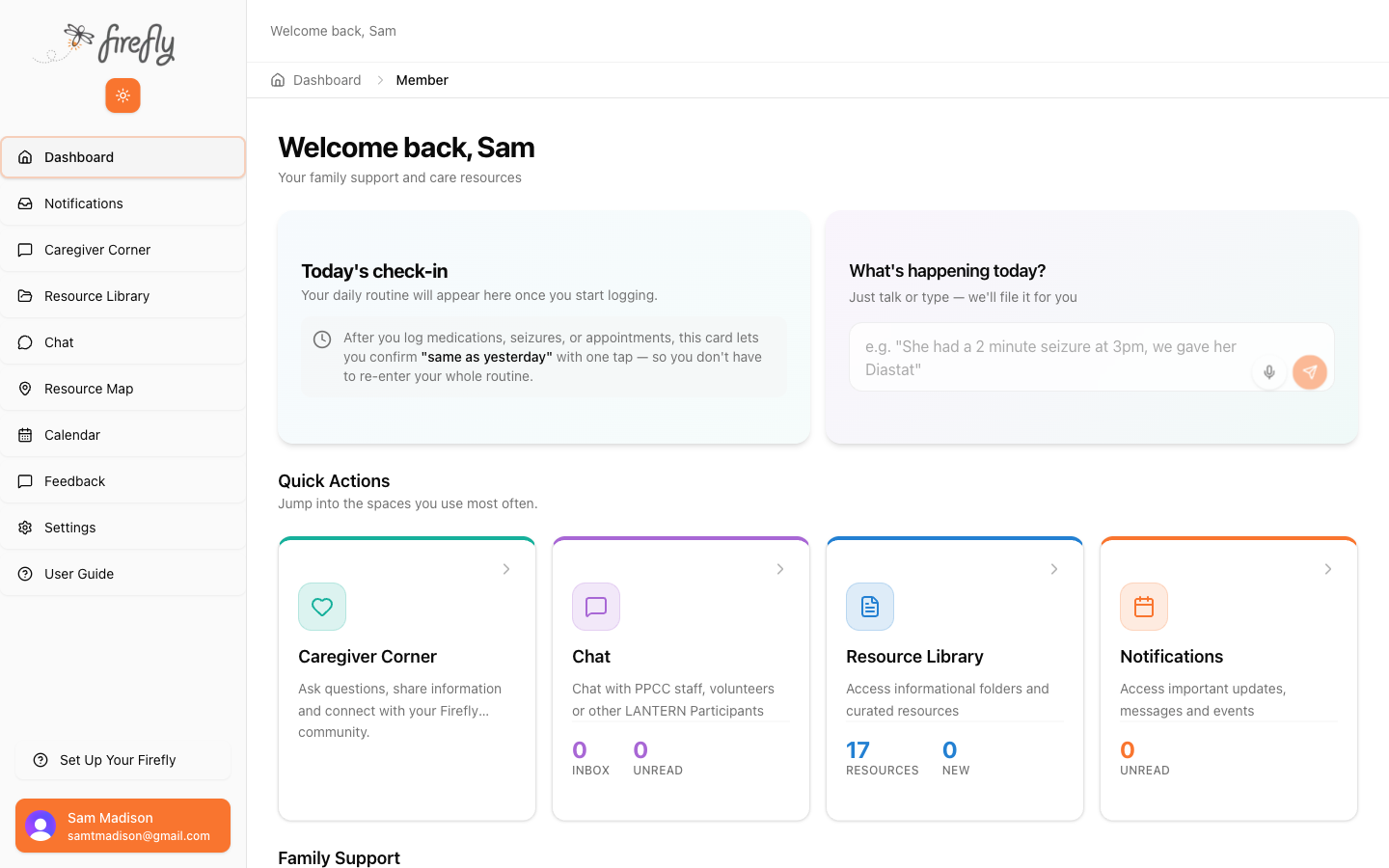
Family Dashboard
Emergency Card at top, daily check-in, quick capture, and one-tap access to resources, care plans, health profile, and chat.
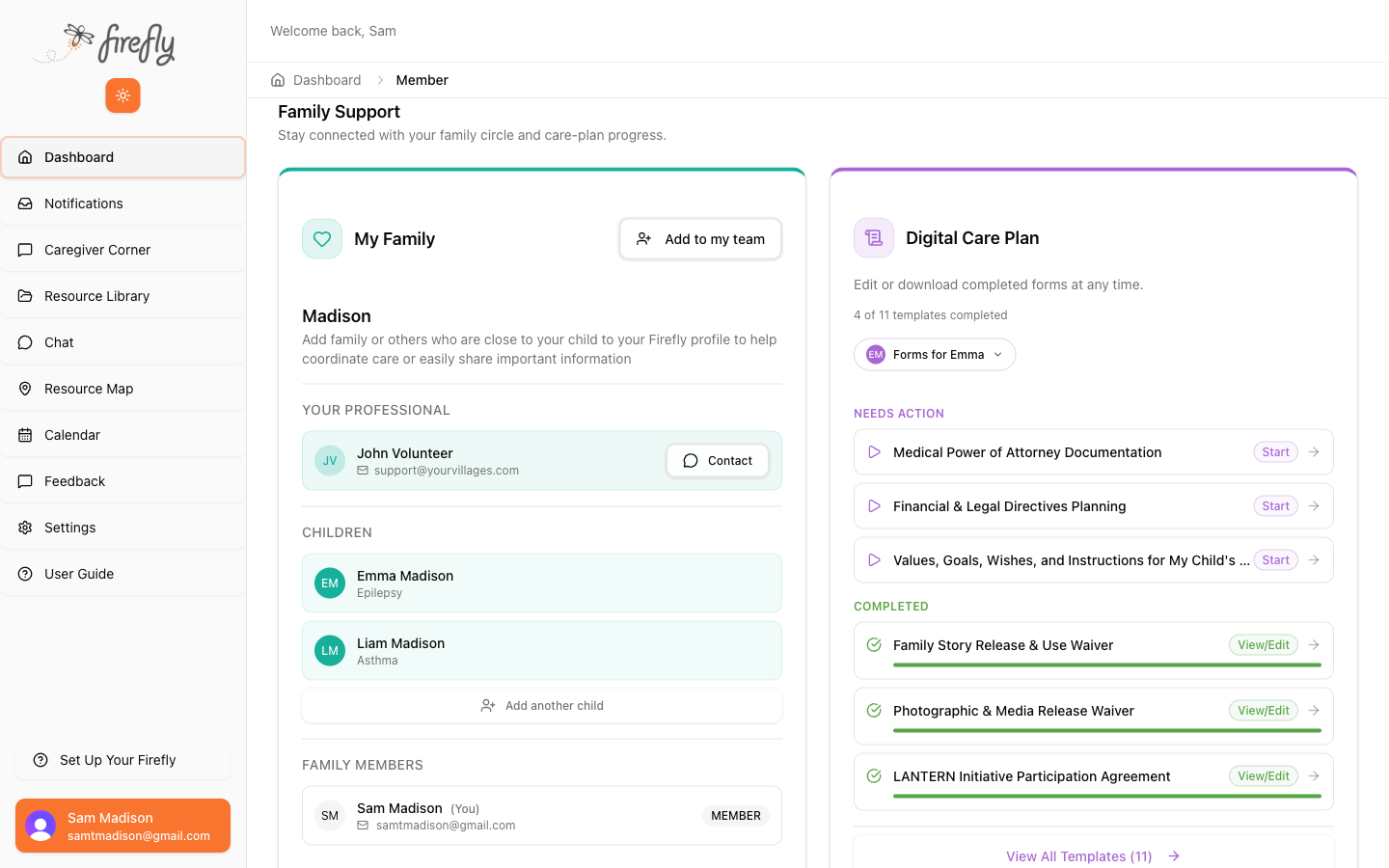
Family & Care Plan
Children's profiles, the assigned care professional, and the Digital Care Plan with clear progress on which templates still need attention.
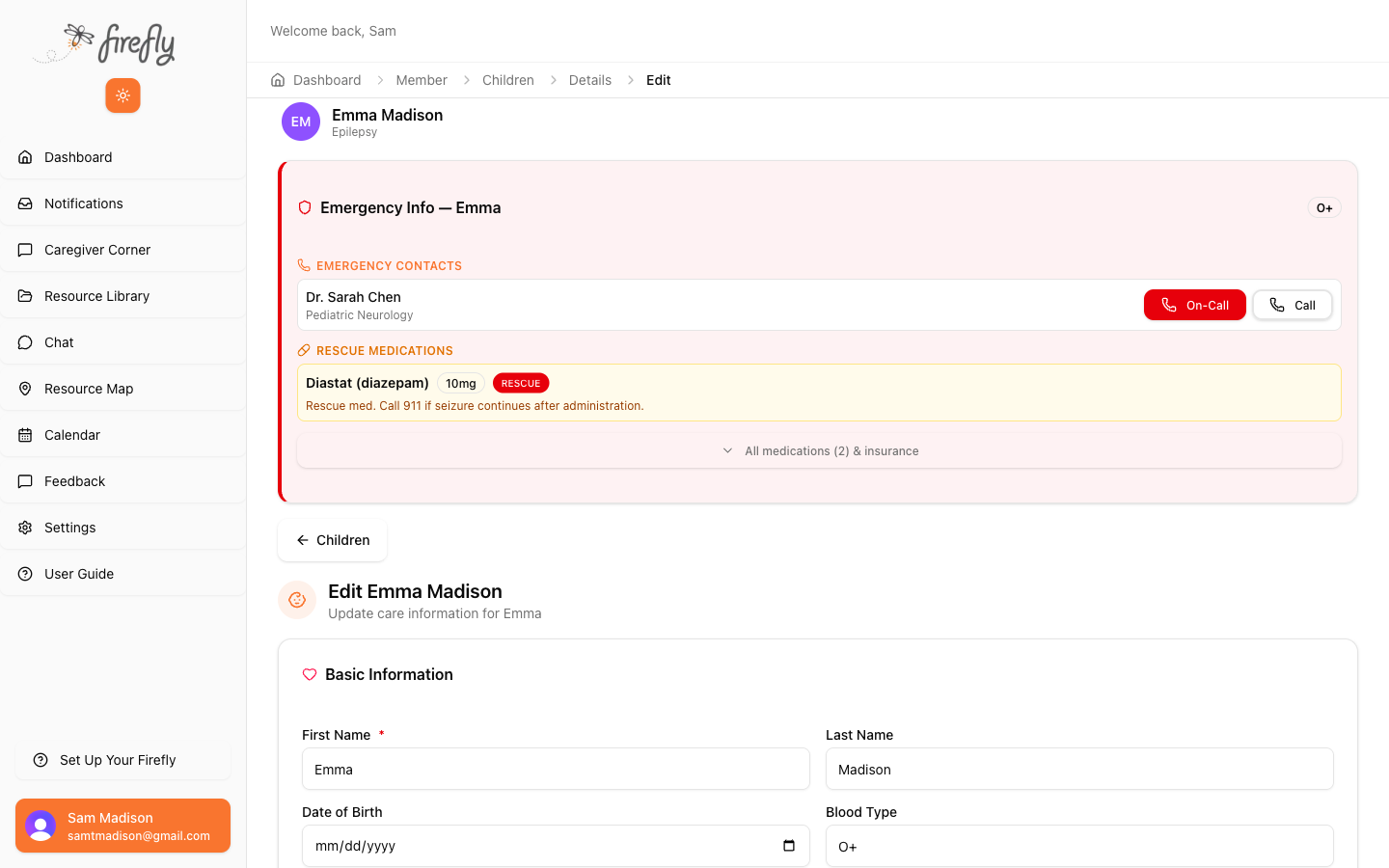
Child Profile & Emergency Info
Each child has their own profile: emergency contacts with one-tap calling, rescue medications with dosing instructions, allergies, blood type, and specialists.
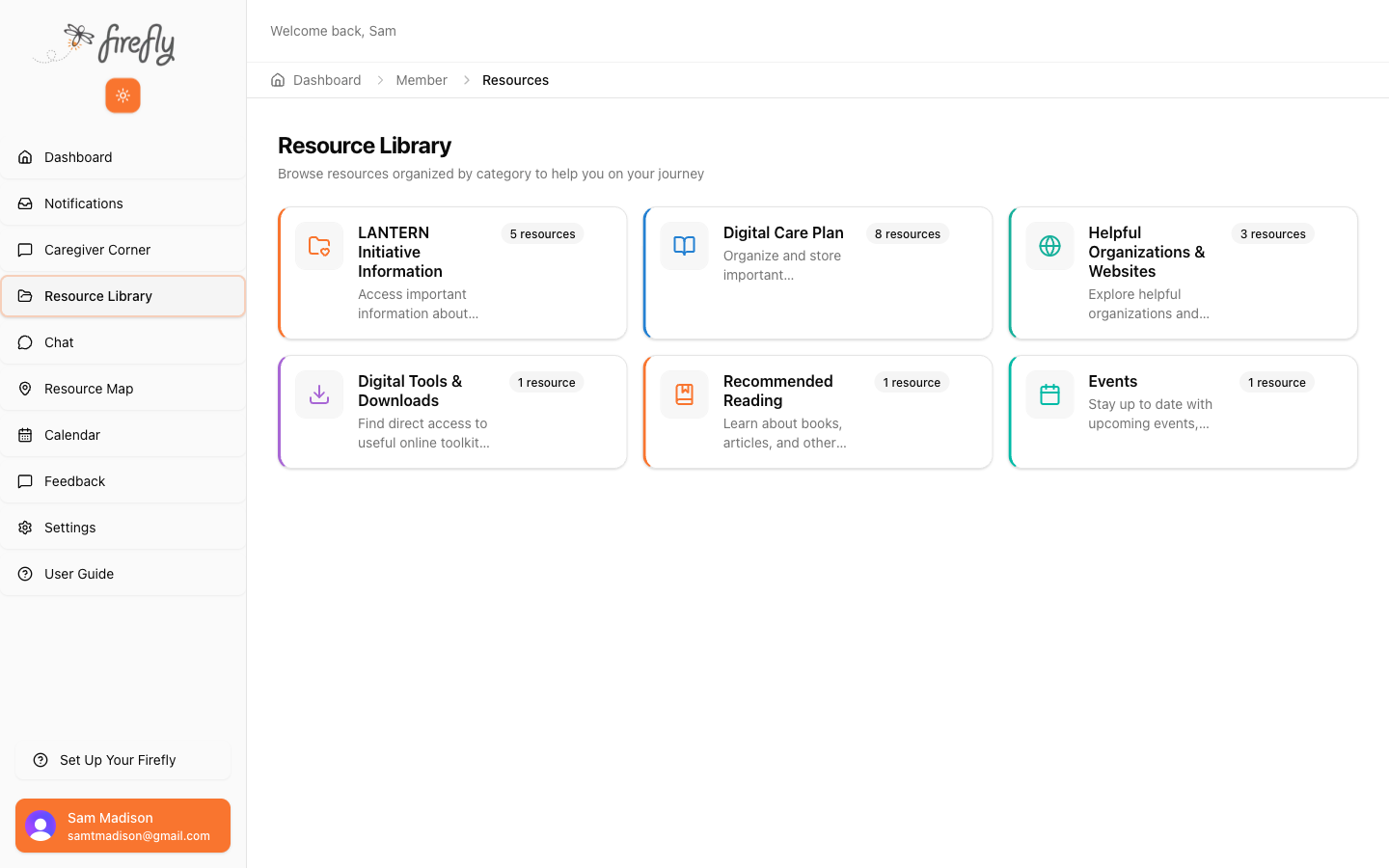
Resource Library
Curated guides, forms, and information organized into clear categories, from care plan templates to helpful organizations and upcoming events.
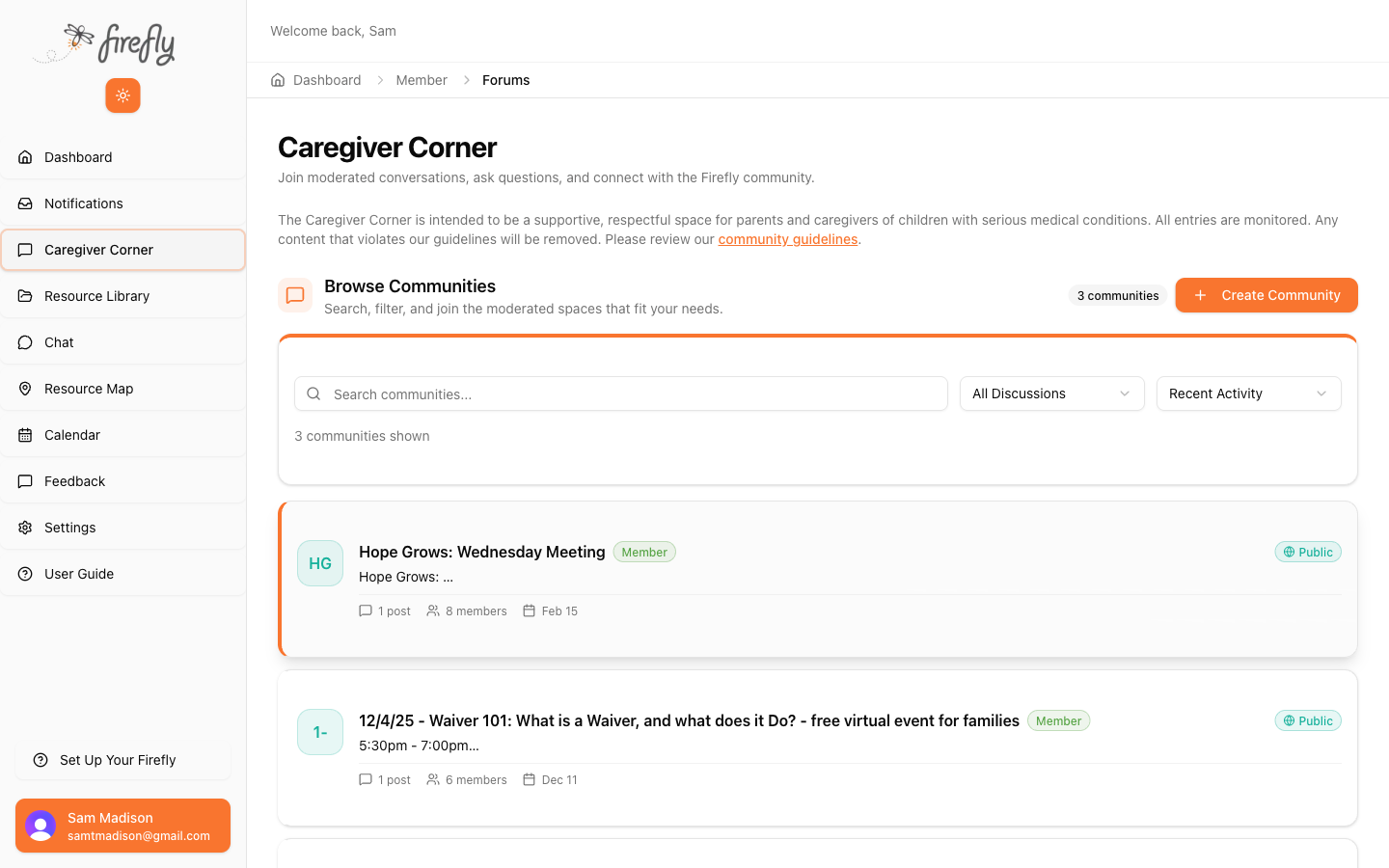
Caregiver Corner
A safe, moderated space for families to connect. Join community discussions, ask questions, and support each other. Real communities, real conversations.
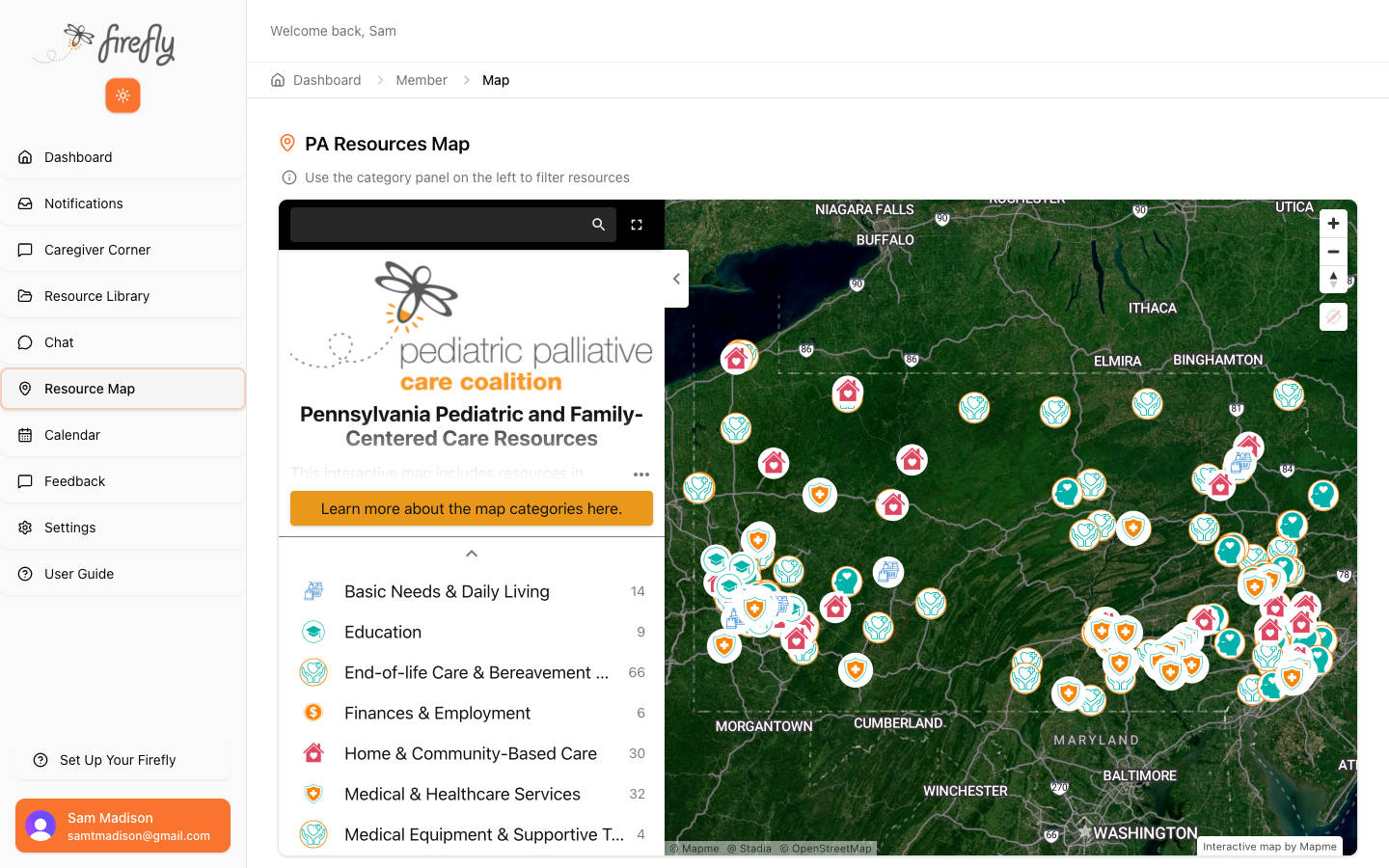
Resource Map
160+ Pennsylvania services across 8 categories. Tap any pin for details and a phone number.
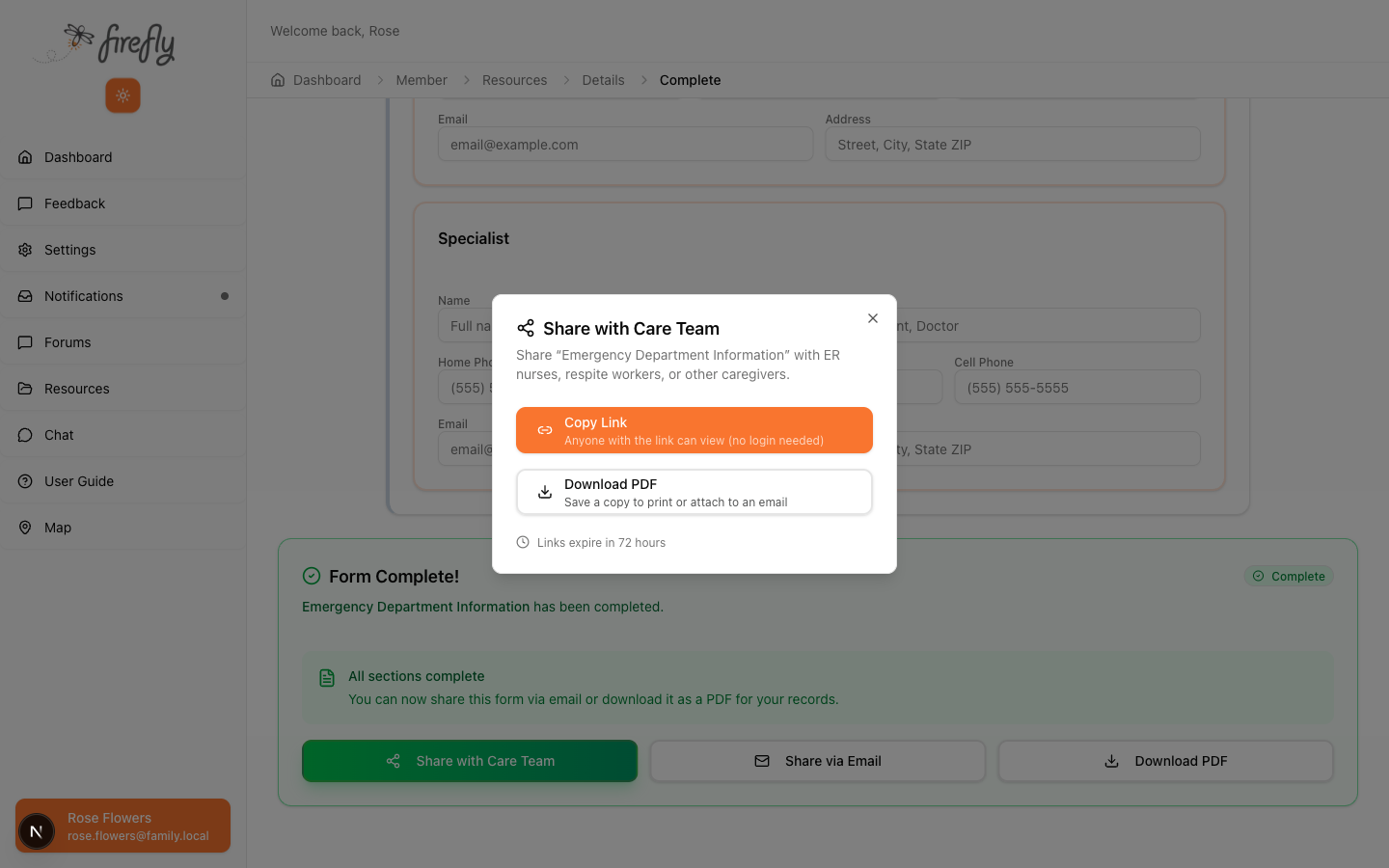
Share with Anyone
One tap to share a child's care plan. Send a link, download a PDF, or email it directly to a specialist, school, or ER.
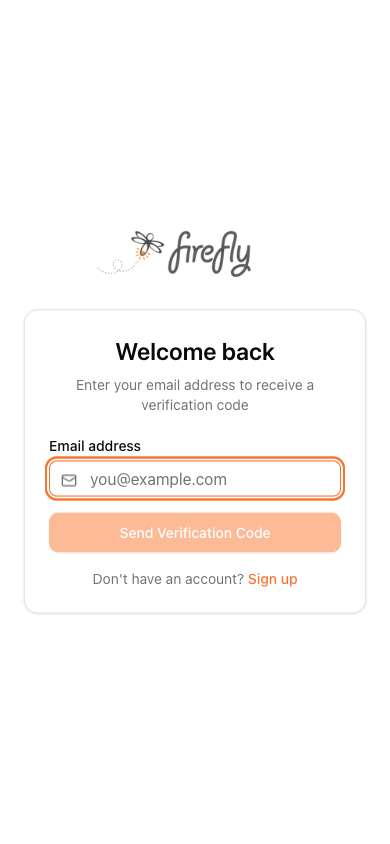
Safe by Design
No passwords to steal. Just a verification code sent to the user's email. Firefly signs users out automatically to protect children's medical information. All messaging is HIPAA-compliant.
A Day in the Life
What it actually looks like when a family and their program team use Firefly on a typical day.
A Family's Day
A Program Leader's Week
What Firefly Does
Three layers working together: families organize their care, navigators provide support, and programs see the results.
What Families Can Do
Parents and caregivers get tools to organize their child's care, connect with their support team, and access the resources they need, all in one place, from any device.
Organize
Connect
Access
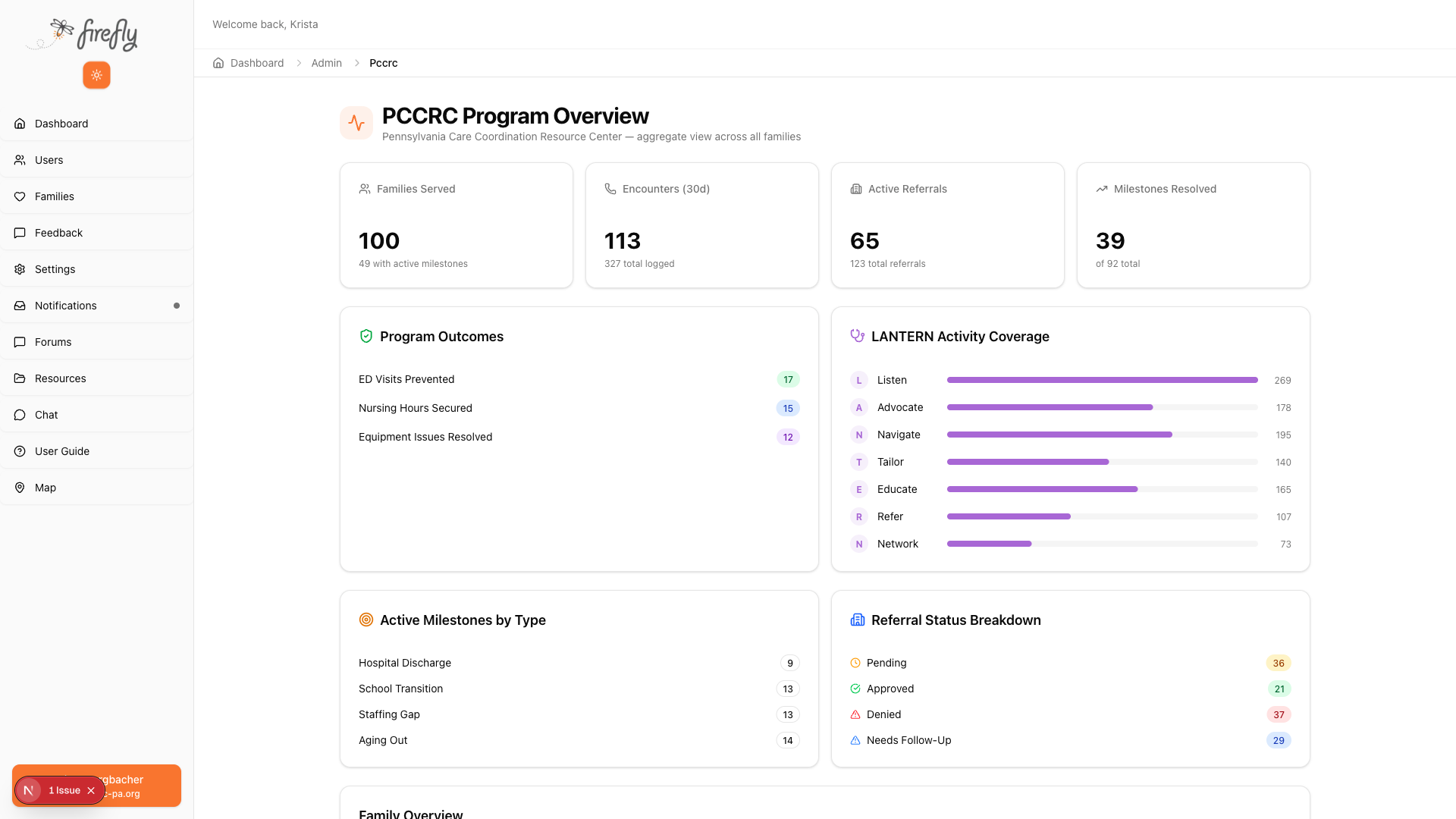
What Programs Can See
Program leaders configure the platform, manage users, and see engagement data: who's active, what's being used, and where the program is making a difference. Program leaders see program-level metrics, not family medical information. A child's medications, allergies, and clinical data are only visible to the family and their assigned care team.
Manage
Understand
Customize
Getting Pennsylvania Right
Families used Lightning Bug. Firefly is the next generation, rebuilt from the ground up with new tools for navigators and program leaders behind the family experience. The focus is simple: get it right here first.
What We've Built
Families can organize their child's entire care plan in one place, message their PPCC team, find local resources on an interactive map, and connect with other families in the Caregiver Corner. Everything is built for a phone, because that's what parents reach for at the doctor's office, at the bedside, or on the couch after the kids are asleep.
What's Coming Next
Firefly launches to families first. These features ship in the weeks and months after go-live, based on what families and the team are seeing.
Fast Follow: Weeks After Launch
For Families
For PPCC Admin
On the Roadmap
For Families
For Navigators
For Navigators (cont.)
Built to Scale
Firefly is built for Pennsylvania first. It's also built so that other organizations serving similar families could use it too, if and when the time is right.
Why This Works
Villages built Firefly as a multi-tenant platform, meaning each organization can have its own branded version with its own data, content, and care model, all running on the same foundation. Nothing needs to be rebuilt from scratch for a new partner.
The clinical expertise behind every template and workflow in the platform came from working directly with PPCC. That foundation is what makes the platform ready for others, not just the technology.
Pennsylvania First
The focus is on getting it right here first. If it works for Pennsylvania families, the same platform is ready for other organizations serving similar populations.
What Each Partner Gets
When a partner organization adopts Firefly, they get their own version, built around the families they serve, the resources in their state, and the care model their team knows best.
Their Own Brand
Their Own Content
Their Own Data
How It Gets Better
Firefly is designed to reduce the burden of care on families. When that burden goes down, good things follow. Families engage more, navigators see clearer pictures, and programs can prove what’s working.
Better Care, Faster
- A family reports a concern
- Their navigator responds quickly
- The issue gets resolved
- The family sees it worked, and trusts the process
- Next time, they reach out sooner
- Earlier intervention, better outcomes
More Complete Picture
- A family fills out a care plan template
- Their navigator sees the progress
- Navigator suggests a related resource
- Family discovers something they needed
- They fill out more templates
- The care plan becomes a living document that grows with the family
Data That Strengthens the Case
- Families log daily check-ins and fill templates
- Navigators resolve issues and log encounters
- The platform tracks it all automatically
- Program leaders pull reports with real numbers
- Funders see measurable impact
- Funding continues, and more families get help
What We’ll Measure
The research says coordinated care makes the load lighter for these families. Firefly is built to track whether that’s actually happening.
These families carry a heavy load. But almost no one is getting the coordinated care the research says they need. only 7.6% of children with complex medical needs receive care in a system that actually works well together (Yu et al., Hospital Pediatrics, 2021). And it’s getting worse: the quality of care coordination families reported actually declined between 2016 and 2022 (Casseus & Reichman, Journal of Pediatrics, 2025).
Family Outcomes
- Care plan completeness: How much of a child’s critical health information is in one place and up to date: medications, specialists, allergies, emergency contacts, diagnoses, equipment
- Time-to-share: How fast a parent can get their child’s information to a new doctor, an ER, or a school nurse. The goal is seconds, not days of phone calls and faxes.
- Emergency readiness: Whether each child has a current, shareable emergency profile a parent can pull up on their phone. In a separate study at another hospital, when emergency doctors had access to digital profiles like these, 98% said the information was accurate and 86% said it helped them provide faster care (Lyons et al., Hospital Pediatrics, 2025). Firefly’s Emergency Card is built on the same principle.
- Resource connections: Families connected to services, organizations, and support they didn’t know about before Firefly
- Less time spent coordinating: Research shows over 40% of families with children who have complex needs spend time every week just coordinating care, and families who spend five or more hours a week on this are twice as likely to skip their own medical appointments (Vasan et al., Academic Pediatrics, 2023). Firefly is designed to reduce that burden through shared care plans, messaging, and one-tap sharing.
Navigator & Staff Outcomes
- Response time: How quickly a family’s concern is seen and how quickly it’s resolved, tracked automatically
- Caseload visibility: Which families have had real contact recently and which are going quiet
- LANTERN coverage: Whether navigators are working across all seven dimensions of care (Listen, Advocate, Navigate, Tailor, Educate, Refer, Network), or spending all their time in just a few
- Care plan engagement: Which families are actively building their care plan, and which ones might need a check-in
Downstream Effects
- Deeper engagement: Families who feel supported don’t just log in. They complete forms, send messages, access resources, and share their care plans. The platform tracks the difference between “has an account” and “is actually using it.”
- Less time on paperwork: Documenting what's happening across the program today means spreadsheets, emails, and guesswork. Firefly captures what navigators are doing and how families are engaging continuously, so the picture is always there when it's needed.
- Earlier signals: ER visits where the family had their child’s care plan on their phone. Referrals that turned into real connections. Concerns that were raised, tracked, and resolved before they became crises.
- A foundation other families can benefit from: Every family who uses Firefly makes it better for the next one. What works for Pennsylvania families can work for families in other states, and those families deserve the same support.
How Firefly Measures It
The research is clear that coordination works. Firefly is built to track whether it’s actually happening, for every family, from day one.
What the platform tracks on its own
Every form completed, message sent, resource opened, concern raised, and encounter logged becomes part of the picture, without anyone filling out a separate spreadsheet or remembering to write it down.
What families tell us directly
At onboarding and quarterly, families complete a short check-in: how confident they feel managing their child’s care, how prepared they feel for emergencies, how often they had to start from scratch explaining their child’s situation to a new provider.
Where the starting line is
Where Lightning Bug data exists, it serves as a baseline. For new families, the onboarding check-in is the starting point. Every outcome is measured against where the family began.
Outcomes Timeline
A clear path from launch to a full outcomes report in twelve months.
Sources
- Nageswaran S, et al. “Collaborative Model of Care for Children With Medical Complexity: A Randomized Clinical Trial.” Pediatrics. 2025;156(2). doi:10.1542/peds.2024-070454
- Lyons TW, et al. “Implementation of an EHR-Based Emergency Information Form for Children With Medical Complexity.” Hospital Pediatrics. 2025;15(9):701-710. doi:10.1542/hpeds.2025-008396
- Vasan A, et al. “Inequities in Time Spent Coordinating Care for Children and Youth With Special Health Care Needs.” Academic Pediatrics. 2023;23(8):1526-1534. doi:10.1016/j.acap.2023.03.002
- Yu JA, et al. “Most Children With Medical Complexity Do Not Receive Care in Well-Functioning Health Care Systems.” Hospital Pediatrics. 2021;11(2):183-191. doi:10.1542/hpeds.2020-0182
- Casseus M, Reichman NE. “Trends and Patterns in United States Pediatric Care Coordination, 2016-2022.” Journal of Pediatrics. 2025;279:114457. doi:10.1016/j.jpeds.2024.114457